Saturday, February 27, 2010
Virtual Storm


Final Paper - Online Education
Understanding New Media – Final Paper
2/27/10
Prof. Strate
If education teaches us anything, it is the fact the nothing remains constant, even the method of education itself. The age old tradition of schooling has changed. No longer is learning confined to the classroom. The ability to gain knowledge has moved outside the walls of the university. Distance education is quickly becoming a vital part of higher learning, but is by no means a new concept. In the 1950’s and 1960’s many universities offered correspondence classes in which students could submit assignments by mail with colleges to complete their coursework. In the late 1950’s through early 1980’s New York University utilized the technology of television in education by offering “Sunrise Semester”, the first telecourse offered for college credit to those who paid registration fees. With the advances in computer technology, distance learning would transform again. For as long as personal computers and the internet have been accessible to the average person, the question of whether cyberspace can be used as an educational tool has been asked, and universities have answered. Online classes began to be offered in the late 1980’s and in 1993, the first online accredited university, Jones International University, was launched. Today, most universities in America offer online classes as well as degrees earned exclusively online. The ability to learn outside of the classroom creates a myriad of economic and geographical possibilities that make it easier for more people to enroll in college courses and earn higher learning degrees.
However, as distance learning becomes a greater force in the world of education, another question must be addressed. Is distance learning truly as valuable as a traditional face-to-face education? The argument continues to rage in academic circles as to whether an online education offers the same benefits as an in-person learning environment. The question of whether a distance learning degree should weigh equally as a traditional degree has been raised as well considering that an online education provides a much different approach to both teaching and learning. The presence of a teacher and students in a physical classroom has been the standard of learning for centuries and though distance learning offers flexibility to the student, does this flexibility in learning result in a loss of quality? The student who learns in a virtual classroom exchanges the complications of in-class education for the problems of online learning. Distance education drastically affects the social aspect of learning as well as the relationship between learning and technology, creating both positive and negative aspects for the student. .
There is no escaping the fact that the cost of college education is rising dramatically. According to The College Board, in 2009-2010 the average cost of a private four year education was $26,273 per semester and $7,020 per semester at a public college. These prices are solely for the education, and do not include travel expenses, the cost of boarding, and meal plans. The high cost of education can no doubt be a deterrent to many individuals seeking a college to attend. The economic issue of in-class education is one that distance learning can offer an alternative to. Though all education can be expensive, distance learning can greatly reduce the cost to the student. Much of the tuition a student pays at traditional university includes building fees, technology fees, and other expenses generated by the need for upkeep of campus facilities and payment of on-campus staff. As Todd Oppenheimer illustrates in, The Flickering Mind, universities see an opportunity for profit by using cyberspace to attract more paying students while being able to circumvent the need for and subsequent cost of a campus workforce and upkeep, thus reducing the price of schooling. Additionally, the student no longer needs to leave their place of residence in order to go to class. In the New York Times article High Cost of Driving Ignites Online Classes Boom, Dr. Robbie K. Melton states, “We had to train more faculty and provide more online courses because students just couldn’t afford to drive to our campuses”. Via the internet, students can reach all of the information, assignments, and course documents they need in addition to being able to interact with their professor, and fellow students. The need to spend money on transportation is then eliminated. No longer does the issue of having to spend money on gas, tolls, or meals from away from home present a problem. Travel becomes an obsolete factor when entering into the world of education in cyberspace, a fact which also alleviates the issue of geographical parameters for students.
The problem of geographical proximity is exacerbated for students who reside in less urbanized areas. Not every individual who wants to attend college lives within a close proximity to one. Those who live in large cities can hardly travel for more than a few minutes without passing some institution of higher education, but what of those who live outside of large cities? The majority of the country lives in major cities but there are still many people in less densely populated areas wishing to attend college. Those who live in more rural portions of the country may have difficulty in finding a school that is readily accessible. In areas that have more land area than population the ability to travel to a traditional classroom environment on a daily basis may be impossible for spatial, temporal, or economic reasons. Additionally, the number of accredited universities in a rural environment many be far fewer than in a more densely populated area. A physical university is an expensive proposition to build from the start. Few institutions would jump at the chance to build a college in a location where the population is so sparse that they would not be able to fill enrollment, thereby being unable to pay for the facilities, teachers, and other costs. Distance education can remedy this situation via its very technology. Due to the fact that students meet in a virtual classroom, their physical location becomes irrelevant. Whether a student is writing from an internet café in the heart of Manhattan, or snowed in at their home in Montana, they are all equidistant from their online learning environment. Ultimately, there are no excuses for missing a class.
It is not only geography that can make attending an in-class lecture difficult, but the problem of time as well. People have always multi-tasked in their lives, but as our culture moves at a quicker and quicker pace, the structured time needed for in-person education can be more difficult to find. As the country has been slow to recover from its financial crisis, people are working at jobs that offer only part-time hours or jobs at non-standard hours of the day to support themselves and their families. With these altered schedules, distance learning offers the solution. Online education is flexible to the user’s needs. In a regular in-class environment the student completes assignments and interacts with their fellow students. Distance learning requires the same tasks, but they may be done at different times which are more convenient to the student. A mother of two with a day job may never be able to attend traditional classes, but would be able to log onto the internet and post conversation topics to a discussion board after her work day is over. Such a person is still devoting time to their education, but they choose the time in which to do it. Due to this flexibility, students may possibly even perform better in their studies. Different individuals focus better at different times of the day. Some people are more cognitively alert and open to learning in the early part of the day while others function better at night. The rigidity of in-class schedules can not compensate for these differences among people and how they work best. Distance learning offers the opportunity for each student to contribute when they are in their best frame of mind to interact and learn in the virtual classroom.
In addition to time flexibility, the on-line classroom offers the student an alternative process to learning. The traditional classroom has always been a teacher centered environment in which the professor directly relates information to their students via lecture or computer presentation, and the student records the information. Once education is transferred into the virtual realm, students begin to learn in a new two-step process. As Paul Levinson states in his article Online Education Unbound, “rather then attempting to inject or spoon-feed information into passive student minds, the ideal online teacher is one who attempts to elicit active student learning” (222). Rather giving information directly to the student, who may or may not be listening, online instructors are more likely to pose discussion topics that will promote a dialogue to open among their students. From this point, the student becomes more responsible for finding their own information and drawing conclusions, participating actively rather than simply taking dictation from an instructor. Once the individual has completed the first half of the process, the information gathering and studying, they must then communicate their finding and conclusions to the rest of their classmates via an on-line application. In this way the process of learning becomes a peer-to-peer education process. As each individual posts their thoughts and views in a discussion forum, and fellow students reply to their posts, students begin to learn from each other.
The fact that students begin to learn from each other does not by any means remove the teacher from the education equation. In any learning environment, the teacher remains the individual with the expertise in the subject being taught. This new method of learning simply changes the role of the teacher in the dynamic of their class. The cyber-classroom makes it virtually impossible for any professor to lecture so the teacher of an online class develops into less of an instructor, and more into a guide. As Gene I. Maeroff suggests in A Classroom of One, “An online course, properly crafted, builds in many opportunities for students to advance their learning through responses and discussions” (42). Through the assignment of discussion topics, assignments, and responses to student dialogue, the teacher of a course can direct their students to new conclusions and thoughts that delve into the subject of a class. Additionally, the fact that there is more opportunity for student interjection in the virtual classroom may also be beneficial to the teacher as well. As more and more students may have one point of view on a topic, and can openly voice them, a teacher may actually gain some new insight from their students on a particular topic. Additionally, a student writing on a discussion board from their home is more apt to bring a radically new perspective to a subject by the simple fact that they don’t have to voice a different opinion in person. Intimidation and self-consciousness are considerably reduced when expressing opinions and interacting within the virtual classroom. The less structured environment of the online classroom opens up new learning possibilities because individuals can voice their opinions so openly and easily.
One of the greatest benefits of an online education is its ability to prepare the individual for the later working environment. Not only is the individual responsible for the gathering of information, but the team approach to problem solving when the individuals gather into a group mirrors the experience of working in a professional electronic group environment. In the professional world it is imperative for the individual to be able to work and communicate with co-workers while also being able to perform individually. The distance education experience offers just such training. The teacher of a distance course takes a less dominant place in the class and students are called upon to think and information gather by themselves, much in the same way they might have to take individual initiative without being given specific information or instruction at their job. At the same, time students must present and discuss their findings to their fellow classmates in a logical and cohesive manner in their virtual classroom, a group environment. Lastly, due to the fact that distance education requires computer skills, students gain a better knowledge and control over the technology that dominates the modern workplace. Most students have some computer skills by the time they enter college, but using the technology quickly, efficiently, collaboratively, and as an information resource is a more refined skill and one that will be crucial in their prospective workplace.
Online education seems to offer almost unlimited possibilities to students and will surely become an even larger ingredient in the future of education. The accommodating alternatives that it offers to traditional in-class education can not be disregarded. However, though distance education provides many positive advantages for students it certainly can not be called a perfected form of education as yet. Distance learning creates new possibilities in interaction, flexibility in class schedules, a greater student voice in the “classroom”, and technical preparation for the workplace, but also presents formidable challenges. Due to the fact that distance education requires a vastly different approach to teaching, it creates its own social, technological, and economic problems that must be examined before instruction is held exclusively in the virtual classroom.
There can be no doubt that socialization is one of the main components of a college education. College does not only give students academic skill, but also offers the opportunity to interact in an adult environment with teachers and individuals of like mind and ambition. The classroom is one of the most important places that this process unfolds. The traditional classroom has always been a place for instruction, but more significantly, a forum where people learn to interact, discuss, and draw conclusions as a group. When students participate in a dynamic classroom they are learning an important skill that will serve them in future endeavors. Interpersonal communication is a much different experience than communication through the buffer of cyberspace. The virtual classroom, in keeping with many theories of the internet, provides a sense of comfort and security to the user. The medium is under their control and they are seated safely alone behind their monitors writing their opinions for their class to see. As Clifford Stoll states in High-Tech Heretic, “The best way to create a community of loners is for each of us to escape into the welcoming arms of the internet” (144). This is a much different experience than having to physically and calmly face a classroom of live students, and present a well-organized, cogent spoken argument. Public speaking and interpersonal communication are vital skills to have, yet at the same time, not a skill that could be practiced through a distance education class.
The lack of interpersonal communication in the online classroom also presents challenges to the student assessment process. No longer physically in the classroom with their students, online instructors have increased difficulty in charting their pupil’s academic progression. Having met a student in person and seen their work habits, an experienced teacher will always be aware when a student is falling behind or even worse, plagiarizing and cheating. When dealing with the virtual classroom, a teacher never gets the opportunity to meet with a student in person and may never have a true understanding of the student’s actual academic proficiency level. With a class that meets completely online, it is possible for a student to leave coursework incomplete, and merely had another individual complete it for them. Unfortunately, an instructor would never be the wiser. In the same way, the instructor encounters an additional problem as far as plagiarism. The internet contains a wealth of information that could be attained and plagiarized by anyone with an internet connection. Though computer programs such as “Turnitin” have been developed to stop the spread of internet plagiarism, instructors are still on losing side of a battle against the sheer size of the internet. Being that neither teacher nor student ever has an interpersonal relationship, it is also impossible for an instructor to ever truly confront a problematic student and rectify the problem.
Distance learning presents other communication and interaction challenges as well. In the traditional classroom environment, there is virtually no time delay between teacher and student interaction. Questions can be asked and points clarified between student and teacher instantaneously. In a virtual classroom it can be harder for a student to interact with their teacher. It is not uncommon for an e-mail, blog posting, or other form of communication to go unanswered by an instructor until it is too late or almost too late to be of help to the student. Certainly the professor who is teaching multiple on-line courses may very possibly miss a question from a single student. Discussion board threads and e-mails can multiply so quickly and become so unmanageable that a single question or comment is easily overlooked. The need for the technology creates an extra step and consequently a time delay between teacher and student that can become frustrating to both. Furthermore as Maeroff points out, teachers will have to retrain to transition to this e-learning environment (90). As online education expands, teachers who may not choose to teach them will be assigned online classes. The teacher being pressed into online classes may either resent the fact of having to do so or may simply be too unfamiliar with the technology to make it a truly effective learning tool. Online learning depends greatly on the teacher’s comfort level with the medium, as well as their ingenuity in employing it. The question then must be asked, are the primary functions of education being sublimated to the technology?
In many ways, technology does become the central focus in the distance learner’s educational experience. With no physical classroom to enter, the computer becomes their only link to education. Technology, although reliable, is not without its problems. We have all experienced personal computer malfunctions, cable outages, or system wide issues that impact technological infrastructures. These periods of malfunction will present serious obstacles to the online student. Since the student is no longer physically interacting with a teacher or classmates, they must ensure that the equipment that keeps them connected is maintained in a state that will allow optimum performance. With the rapid advancements in technology, computer hardware and software becomes obsolete at a startling rate. A computer bought for a college freshman today will be outdated and inadequate by the time they receive a four-year degree. Additionally, the user must worry about system upgrades, software upgrades, as well as application and programming compatibility in order to be able to run all of the programs required to participate in online classes. These hardware and software upgrades can be an extremely expensive proposition for the user. Not every student may have the financial resources to maintain their equipment adequately. At the very minimum, the user must have at least a basic understanding of how computer hardware and software work and interact. At times, even the most savvy of students can run into a problem with the technology that they do not know how to fix, or worse, a complete technological failure. Because computers are mechanical, they are subject to breakdowns that even the most talented technician could be unable to fix. Technology is fallible in a way that the human is not. This is one of the primary benefits of an in-class education. The spoken word will never crash and be wiped from the page, will never lose its internet signal strength, and will never need a battery life or power source to be able to read it. As the computer and the internet are the primary tool of distance education, the technological aspect of instruction will always create a gap, however small, in the immediacy of the learning process as well as depend on its mechanical operation.
It is not only immediacy that is compromised by distance education, but the possibility of learning in a hands-on environment as well. Due to the fact that distance education is done solely through the computer, there are many physical skills that the student will be unable to learn and certain subjects that can never be taught successfully online. Many studies in the medical field, the scientific field, and even the technical aspects of communications could never be taught via distance education. The possibility of learning the practical technique to becoming a surgeon, engineer, or camera operator is obliterated by the lack of physical instruction and actual facilities to apply the student’s knowledge. The debate has always raged as to whether an online degree is equivalent to that of a traditional college degree. In this instance, the online degree is severely lacking. As Paul Levinson suggests in his article Online Education Unbound¸ to a large degree, online education can only offer a theoretical understanding of a subject, while falling short in offering opportunities at practical applications of the new knowledge being absorbed. Practical demonstration of the skill learned is impossible in an online forum. In advocating online learning, universities wanted to remove the need for physical structures thereby cutting operational costs. In the process however, they removed the facilities which enables students to learn practical skills were removed. The student may be paying less for their distance education, but they are also being offered less opportunity to learn in a physical hands-on environment.
Although online degrees may perhaps be more effective for the student, there is not always a commensurate saving for the university itself. As Stoll suggests, the materials and specialized technical staff needed to create, operate, and maintain an online education program can be a major cost to a university (23). The institution, seeing online education as a for-profit enterprise, may attain some government funding for the project. Additionally, it would have to rely heavily on outside funding and tuition to raise the remaining resources, an issue that presents a two-fold consequence to the student. Universities will have to increase tuition for both online and traditional students to pay for this infrastructure. Not only would this be unfair to the students who are paying for a traditional in-classroom education to fund online courses, but might even dissuade any anticipated distance students from enrolling. The creation of a distance education program can also be hazardous to universities when looking to outside corporations for funding. Maeroff points out that in an attempt to fund on-line education programs, many universities have chosen to locate companies who would underwrite the cost in return for a voice in the curriculum (122). This in turn puts the onus of complying with the company’s requests squarely on the university’s shoulders. If such classes are not to the satisfaction of the specific company, the business could pull their financing to the university creating further financial difficulties and possible tuition increases.
Of all of the potential problems of online educations cost to universities, the concept of corporate funding is possibly the most unsettling. The ramifications of corporate financing to universities or the creation of un-accredited and un-affiliated for-profit educational institutions by corporations threaten the very mandate of higher education. As more and more universities seek outside corporate funding to help support distance learning programs, one can only wonder what affect the new sponsorship will have upon the education being provided to students. College has always been a forum for the flow of information and free thought. With corporate sponsors involved in the financing of education, the intellectual haven that is the university may be under threat. Whether a business is giving funds to an advertising agency, a charity, or an educational institution, that corporation wants to make sure that they, as well as their causes and policies, will be presented in the best possible light. The cause for concern is whether corporate funding to schools will begin to dictate what is being taught to students. The oil refinery corporation offering funds to an educational institution may not be in favor of their funds being used to teach liberal “green” politics to students, and could always threaten to pull their funding if continued. Depending on the situation, the university might be unable to sustain the financial loss and be forced to change what it is being taught in classes.
The use of distance education has both positive and negatives attributes. No single conclusion can truly determine whether it is more or less effective than a traditional in-class environment, especially since every student has different needs, every teacher has a different level of comfort with the technology and both may prefer a different approach to learning. The individual must decide what the best choice is for them. Flexibility must be made for students who have problems of geography, time, or economics, but this does not mean that the traditional in-classroom education should become obsolete. Whatever the case may be, as a whole, the academic world must not forget that what is being debated over is education of people. As Todd Oppenheimer states, “In the end, the legions of education critics who incessantly pester the schools to make dramatic changes would do well to remember one central fact: At its core, education is a people process” (395). Each method of education offers something to the student while posing its own problems. Possibly, it will always remain a combination of both traditional and distance education that will be most successful creating the best learning environment to students. Perhaps this hybrid will be the most effective learning environment -- one in which students and educators can use the benefits of technology as a tool, while maintaining the human connection so vital to the education process.
Works Cited:
Dillon, Sam. “High Cost of Driving Ignites Online Classes Boom.” New York Time on the Web 11 July 2008. 25 Feb. 2010 http://www.nytimes.com/2008/07/11/education/ 11colleges.html?pagewanted=2&_r=1&sq=online%20college&st=nyt&scp=19
Levinson, Paul. "Online Education Unbound". Communication and Cyberspace. Cresskill, NJ: Hampton Press, 2003.
Maeroff, Gene I.. A Classroom of One. New York: Palgrave Macmillan, 2003.
Oppenheimer, Todd. The Flickering Mind. New York: Random House, 2003.
Stoll, Clifford. High-Tech Heretic. New York: Anchor Books, 2000.
Digital World Paper
Even when we are performing the mundane tasks of
information processing, we always bring part of ourselves
to the digital applications with which we interact. Digital
applications are never fully transparent; they always reflect
the user.(Bolter, 62)
From our choices of music to the software we utilize, our transactions in this electronic world reveal something about ourselves. Many activities that we regularly do have something to do with the digital world. When we want to get in touch with someone, we can send them mail via the virtual world. We can write letters by typing on the computer and with a click of the ‘send’ button on the screen your message is sent instantly to the receiver. It is completely different from writing your message on paper, sealing it in an envelope, and possibly waiting a few days to get a response. In the past, letter-writing was considered almost an art form, with time set aside for carefully composing our thoughts and sending them out. The letter writer was conscious of the fact that grammar, spelling, and correct punctuation were important. Nowadays, people just scribble out whatever they want in emails, emails filled with abbreviated words/phrases such as “lol” or “btw.” We would appear to have replaced the long task of letter writing with the quick, short bursts of emails, a process very much like what Neil Postman described in his book Amusing Ourselves to Death, where television and its constant barrage of short messages erodes our concentration. (This is also picked up in Walter Ong’s Orality and Literacy. And this “snippet”mentality is addressed in the article “Is Google Making Us Stupid?”) Did this happen overnight? Have computers and by extension, the Internet, become such an important part of our society that even political races are now fought in the digital world, where Obama is called the “wired president.” (Griggs)
The Internet was first developed by the U.S. Department of Defense to communicate electronically with its allied countries to prevent an attack from the Soviet Union and other communist nations. It was comprised our linked computers among the Department of Defense, major industrial corporations, research institutions at universities, and selected overseas sites. Bolter and Gromala state that at the beginning: “The Internet once belonged exclusively to the Structuralist, a community composed mostly of graduate students and professors in computer science, who seldom ventured outside their cubicles” (p.3) but today, it can be found worldwide and has multiple purposes: it can speed along medical diagnoses, reports on upcoming weather, broadcasts live entertainment as well as breaking news, allows you to make purchases on line, and leads you to millions of online books, many available for free. The designers were right about one thing: the World Wide Web would be similar to a magazine page with a good amount of information. Now, the computer has been able to combine several media into one. We can watch clips of TV show on YouTube, listen to radio shows and music videos via iTunes; the possibilities appear to be endless. Again, our wired president can get on YouTube: “…Obama on YouTube suits today’s world, in which people want to be in touch with their president, or at least hear and see him, at times of their rather than the president’s choosing….In the fast-changing 21st century, the biggest reassurance about information is knowing it’s there.”(Levinson, 66)
Computers have gone through many stages throughout history from the abacus to multi-piece equipment today. The abacus, invented about 5,000 years ago in Mesopotamia, was used by merchants to keep a record of trading transactions. It is still in use today and consists of sliding beads. It revolutionized business by allowing merchants to correctly tabulate not only prices, but it also allowed them to accurately count their merchandise. Thousands of years would pass, however, before the next great step into computation would be made.
In 1642, Blaise Pascal invented what he called a numerical wheel calculator to help his father with his tax collecting duties. The device, which would be called a Pascaline , was designed mechanically so every time each digit moved ten notches, the digit to its immediate left moved one notch. The device had a capacitance of eight digits. While useful, the Pascaline did have its limitations – it could only add.
In 1694, a German mathematician and philosopher, Gottfried Whilhem von Leibniz improved the Pascaline by creating a machine that could also multiply. While an improvement, these calculators were not widely used. “It wasn’t until 1820, however, that mechanical calculators gained widespread use.”(JT)
A Frenchman by the name of Charles Xavier Thomas de Colmar invented what he called the arithometer which could perform the four basic mathematical functions: addition, subtraction, division, and multiplication. His device was used until World War I.
The real start of computers as we know them today started with Charles Babbage. In 1822, Babbage theorized that the “Difference Engine,” powered by steam, could perform many calculations using a stored program. Babbage worked on the design of the Difference Engine for ten years and then decided to go to the next level: he proposed the creation of an “Analytical Engine,” again powered by steam and using stored programs. Perforated cards would contain the operating instructions and a “store” of 1000 numbers up to 50 digits long would also be housed in this engine. The engine would also print out its results. This engine was never constructed because it involved over 50,000 parts, but the essential features of his intended invention are very similar to what a modern computer does. His great supporter and collaborator in this project was Augusta Ada King. So influential was her help and creativity that the Department of Defense named a programming language – ADA- after her. And what is very interesting is the significant role women eventually had in the development of modern-day computers and programming.
An American inventor named Herman Hollerith found a way to store data on cards, which was very useful in taking data for the U.S. Census. Officials at the Census Bureau were concerned about the time it would take them to count the results from the decennial census; the 1880 census had taken seven years to count, and the officials were afraid that the 1890 census would take much longer because the population had grown so much. Hollerith devised a method where single punch in a card represented one number, and any combination of two punches represented one letter; as many as 80 variables could then be stored on a card. (What we call a “punch card.”) With this new mechanical calculating device, the results for the 1890 census were completed in six weeks, compared to seven years from the 1880 Census. Not only did the punch cards reduce computational errors, but they also acted as storage devices for future reference. Punch cards were the most commonly used way of computing data in the manufacturing and business industries; in fact, they were still being used in the 1970s.
The era of modern computing began during World War II. There was a race between the Nazis and the Allies to come up with the first electronic computer. While the Germans used computers to build airplanes, the British invented Colossus, a code-breaking computer that could decode secret German messages. Thus, the Allies had a huge advantage since they could track every move of their enemies, whether it was on the ground, in the air, or beneath the sea. However, the contribution to the computer industry was limited because the Colossus was only programmed to decipher secret codes. “American efforts produced a broader achievement, Howard H. Aiken (1900-1973), a Harvard engineer working with IBM, succeeded in producing an all-electronic calculator.” (JT) The Mark I used electromagnetic signals, to move the mechanical parts to perform addition and other complex functions. The calculations took about 3 to 5 seconds for computing result, and were inflexible. It was only used to graph ballistic charts for the U.S. Navy.
The ENIAC was developed in the 1940s and was jointly produced by the U.S. Government and the University of Pennsylvania. They were only using the computer as a machine to compute problems in science and engineering. A scientist named AlanTuring knew that computers could do more than transform and translate messages; they should be capable of producing their own results. “For Turing and others, who followed him, the computer should not just be a channel for human messages; it should be a thinking machine, capable of producing its own messages.”(B&G) He wanted computers to socialize with each other instead of acting independently. Turning came up with the Artificial Intelligence (AI) movement saying that computers, physical objects, could exhibit qualities of the human mind. Even though this turned out to be not true, the idea remains very strong. “All the scientific and engineering uses of the computer, the business information systems, the databases and text archives, and more recently the spreadsheets and word processors in personal computers, are expressions of the computer as symbol manipulator” (B&G).
The ENIAC was the first general-use computer and could make calculations one thousand times faster than the Colossus or Mark I. The machine consumed about 160 kilowatts of electricity. The EDVAC (Electronic Discrete Variable Automatic Computer) was the first computer to have a stored memory as well as data. The central processing unit (CPU) allowed all computer functions to be controlled from a single source. The CPU socialized with the computer to perform what functions needed to be executed at any given moment. “First Generation computers were characterized by the fact that operating instructions were made-to-order for the specific task for which the computer was to be used.” (JT).
However, the transistor came into play during 1948 which helped computers become smaller, faster, more energy-reliable and efficient machines. Second generation computers also had stored program and programming language. The stored program allowed computers to become more flexible by having a setoff instructions inside the memory so one function could perform one task, and another task could be done immediately. Programming languages came into use during this time, which had words, sentences, and formulas so a computer became much easier to program.
The third generation or Modern Computers was from 1964 to 1971. An important development during this era was the integrated circuit. The IC had the electronic components on a small disc. Later on, more components were put on a chip, meaning the computer could store and perform more functions. An operating system allowed the machines to run on many different programs while a central program coordinated the memory.
All these advancements, however, had not really impacted on the everyday lives of people. While computers had been necessary to get men on the moon, the benefits of computers on a more personal level had yet to be realized. That would come about in later years.
A big development during the Fourth Generation from 1971 to today were the number of components on one chip; this increased exponentially. “The Intel 4004 chip, developed in 1971, took the integrated circuit one step further by locating all the components of a computer…on a minuscule chip.” (JT) What this meant was that computers were becoming more accessible. A timeline for this generation of computers reads:
1970s – The microcomputer for enthusiasts
1975 – Computers in the office
1980 – The IBM PC
1984 – The Macintosh
The period of the “HOME” computer
And since then…
The INTERNET
For the Millions (Lee, 6)
Starting with this generation, the computer starts to become a vital part of the office and later the home. It is during this time period that the first email systems start; that the term “personal computing” is used. The first computerized systems were, by our standards, rather primitive. There were no graphics, the results were all text-based. But, of course, that would change:
Just as those glued to their television sets for
six or seven hours a night reasonably prefer sets
with PIP(picture in picture), which lets one see
the action of more than one channel at once….,
so, too, do workers chained to computer monitors…
naturally prefer to have a large screen with 16 million
possible shades and hues of color, with a number of
programs opened at once. (Phelan, 52)
Now that computers have become an essential part of our existence (who would give up what we have?), a lot of questions crossing many societal functions need to be addressed. With computers in charge of everything thing from traffic lights to bullet trains, how is society being transformed? What questions do we need to address in this digital age?
Like the printing press of the 15th century became an “agent of change” for Western Europe, how has the computer and, by extension, the Internet, become a transformer of everyday life? The printing press wrested away from the hands of the few (nobility and the Church) communication and information and widely disseminated them to others not under the control of the elite. So, too, computers have changed the very society in which we live, allowing information to travel freely and instantly to all who have a computer and Internet access. The rise of the “citizen-journalist” is seen again and again, from the plaza of Tiananmen Square to the horrible pictures out of Haiti. Government accountability and public scrutiny have opened up channels of dialog previously unheard of. Look how many members of Congress have Twitter accounts, Facebook pages, or YouTube channels. (Visit the sites of our two New Jersey Senators and see how “wired” in they are: Robert Menendez can be reached at http://menendez.senate.gov/ or Frank Lautenberg at http://lautenberg.senate.gov/).
Obviously, this digital world is not going away, but as so often happens with new technology, we develop new tools before we understand the full repercussions of them. While the ease and instant access of the Internet are beneficial, the quickness with which lies and deceit can be generated also has to be accounted for. Identity theft and cybercrime flourish to such an extent that the FBI has special task forces devoted to these two types of crime. And instances of both these crimes keep on growing. How often are we told not to open emails from addresses we do not know? Or aren’t we always being warned about giving out any personal information over the Internet? Craigslist was even used for a bank robbery! (Levinson, 175-76)
It would seem as if for every good thing that computers/the Internet can give us, there is a dark side as well. But maybe that is just human nature.
No one doubts that business has been transformed by the Internet: instant shipping and billing, the ability to track purchases, the immediate electronic transfer of funds, less reliance on paper and its attendant costs are among some the benefits enjoyed nowadays. It is also true that trying to get a problem corrected in the digital business world is very frustrating. Amazon is known for its vast inventory and shipping abilities, but have you ever tried to reach customer service? For one, Amazon does not even list a customer service number, just a generic “contact us” link, and even when you finally get the number, no one ever answers at the other side. Many customers are frustrated by this level of service, not just with Amazon but with many large companies. That is why the web site “gethuman” has proven so popular; this site allows you to speak with a real agent in seconds, rather than being bounced around like an electronic ping-pong. In building a Web presence, many companies have lost sight of the importance of the human touch; it does not have to be that way in the digital realm.
Another pitfall as far as businesses go is their checking on job applicants by accessing their Facebook or MySpace accounts. Interviewees have no idea of how any negative pictures, comments, or postings on what they think are “private” sites actually are being accessed by people who are definitely not their “friends.” While this is certainly not an invasion of privacy, businesses are certainly exploiting the Internet for their own good. I guess a businessperson could just say they were looking out for their own company’s well-being. Hopefully, people will be more restrained in what they post on web sites. There would appear to be a disconnect between business and people. Business uses the Internet as a way of streamlining their operations, while people use it to connect with others. And if businesses are making it harder, not easier, to communicate with customers, where is this going to lead us?
Computers have indeed impacted all aspects of society, including education. My Dad tells me that when he was in school, his computer was a slide rule; nowadays, every classroom in every school building in my town is connected to the Internet. The library in my town has waiting lines for people to use its computers for all kinds of purposes. “Online learning” is now an accepted part of the academic experience; FDU requires that its undergraduates take four online courses. And the University of Phoenix now enrolls more students in its online courses than any other university in this country. (Berger) Levinson, in his article “Online Education Unbound” written in 2003 states “…one may wonder why online education has not taken the academic world by storm.”(222) In 2010, I think the storm has already arrived. According to an article in the Bergen Record:
Americans have flocked to online courses in
the past decade. More than 4.6 million post-
secondary students, or 1 in 4, took at least one
class via the Internet. That’s up 17 percent in just
a year…. (Whitley)
More and more students are opting for this form of education, especially adults who cannot leave work at odd hours to attend physical classes. Since much online learning is asynchronous (meaning it is not a real-time conversation between students and instructor, but rather an interaction which takes place when the student gets around to it. The instructor’s notes, assignments, and comments await the students in cyberspace and can be accessed at any time without the intervention of the instructor), students can plan more easily as to when to access their classes. Such classes require no travel time, and in the event of bad weather such as we had not so long ago, classes in cyberspace are not canceled because of bad weather unlike their physical counterparts. More and more universities are advertising entire master’s or doctoral programs which are totally online (with a few weeks’ of actually being on campus to satisfy accrediting agencies’ rules). This is proving to be a great advance for many people who previously were shut out of higher education. In certain instances, you can now get a degree from a major university, not even in your state, by “attending” classes online. At Rutgers, “Online enrollments in 2010 project to be 80 percent higher than in 2009….”It took us ten years to get to 500 students…And three semesters to get to 5,000.’”(Whitley) In England, the Open University is really paving the way with its various programs and innovative offerings. Even a U.S. citizen can take classes there. Imagine attending a British or European university without actually having to be there! So widespread is this becoming that YouTube has a separate channel called YouTube.edu which features thousands of university lectures and courses on a wide variety of topics. Of course, watching these videos does not give you course credit (after all, higher education is still a business and relies on tuition), but it does open up new worlds for you to explore freely. This democratization of higher education will have great impact on the workforce in the near future. Online higher education is still not just available to anyone, you still have to meet entrance qualifications. But is does allow you, once you are accepted, to take courses from the convenience of your home. Not everyone lives within an easy commute of a college campus; we in the Northeast tend to forget that.
Another thing we forget is how lucky we are to have access to the digital world. There are computers and Internet connections wherever we go: home, school, or library. There are wireless points of access in so many places now; in fact, entire cities are going wireless. We can connect to the Internet via a wide variety of products, from a desktop computer to our cell phone. Nowadays we take this for granted, especially those of us in college where connecting to computers and the Internet is a given. But not everyone has such ease of access to such high-powered connections; not everyone has broadband access; not everyone even has a computer. That is where the term “digital divide” comes in, the phrase used to separate the haves from the have nots. It exists not only in other countries, but it is here in the United States as well. It is good to remember that not everyone even in the most powerful country on Earth has electronic tools. We assume that poor countries like Mexico and others in Latin America(Estache) do not have access to computers or the Internet. In Mexico, for instance, the government launched a program called e-Mexico which had as its goal the ability for its citizens to use the Internet through “telecenters,” or cybercafés equipped with all the modern technologies.(Executive Summary) But have we really thought that this lack is also prevalent in our country? That digital divides exist is not under question here:
Throughout history, there have been divides between
those who adopt and fail to adopt new technology. It
took centuries for literacy to become the received
position in most societies and it is still not universal.
there are still those who have either no or severely
restricted access to education, to literacy, to books,…
and so on. (Dance, 176)
It certain cases the lack of access is geographic (Vermont), economic (inner cities), religious (those communities which reject modern technology like the Amish), or political (repressive regimes). However, in all cases, these people are disenfranchised, they cannot participate in the global dialog occurring around them. Efforts to bring computer access to all peoples have been a slow process; out of the world’s seven billion people, less than 2 billion have access to the Internet. (Internet World Statistics 2010) Most people are concerned with more urgent matters, such as securing clean water and food, or finding a safe place to live. Again, we take this digital world so much or granted that we do not realize that most of the world is disconnected. It is changing, that is true, but it will be years before the entire world can be said to be connected.
Repressive states control the flow of information whether that information is in print or electronic form. For example, in Saudi Arabia:
Journalism is strictly controlled, and journalists must
exercise self-censorship in order to avoid government
scrutiny and dismissal….the media environment within
Saudi Arabia is likely the most tightly-controlled in the
region. The kingdom’s four TV networks…and its radio stations
are operated by the state-owned Broadcasting Service of the
Kingdom of Saudi Arabia….Private television and radio
stations are prohibited on Saudi soil.
-(Internet Filtering in Saudi Arabia, 1.)
In such an oppressive environment, access to the Internet is severely limited. In this 2009 report, the 25 ISPs allowed in the country are connected to the national network which is controlled and filtered by a government entity.(p.2)
A recent article in the Wall Street Journal examines state-controlled Internet access:
It’s fashionable to hold up the Internet as a road
to democracy and liberty in countries like Iran,
but it can also be a very effective tool for
quashing freedom (Morozov)
OpenNet Initiative has documented dozens of countries in which complete and open Internet access is denied. Surely, the people living within these countries fall on the wrong side of the digital divide. Many are educated individuals aware of the benefits of the Internet but are denied its use because of governmental filtering. Even in the United States, filtering of the Internet is allowed, especially when dealing with child pornography. (Internet Filtering in the United States and Canada, 1-9)
Those who live in the lower socioeconomic brackets cannot afford the broadband access to the Internet or even afford the price of a computer. Hence the schools and the public libraries play a major role in allowing people access to computers and the Internet. But, as always, there is more demand than resources, there are long lines, and no building is open 24/7. And with increasing pressure on local budgets as tax receipts go down and state aid is cut, the local public library cannot offer the hours of service or the staff expertise to assist people. For example, the State of New Jersey is NOT providing paper copies of income tax forms this year to libraries or post offices; people will have to download these forms. But what if you don’t have access to a computer or the Internet? And even if you do, do you even know how to use the keyboard, let alone navigate the web sites? And to add insult to injury, libraries which are always strapped for money, can no longer afford to print these documents for free. The library patron must now pay for this service, and what if you need to print out the lengthy booklets that go with the forms? Again, these people are on the wrong side of the digital divide.
We need to remember that just because we take something for granted doesn’t mean everyone has it. There are probably people in my own town who fit the above profile. They are being denied an equal opportunity to avail themselves of a powerful communications/information product.
Another area of concern is the amount and quality of information available via computers and the Internet. A recent report – How Much Information – details the overwhelming amount of information out there. Most information is not in paper or print form, that medium now comprises the smallest share of the information world. (p.18) Our problem is how are we to establish what sources of information are valid? No one controls what is placed on the Internet; there is no editor to make sure that what we read is actually correct. The Internet is like the Wild West, and there is no marshal in town. Those who “have not” cannot even access the bad data, let alone the good. One has to be very careful in determining the validity of the information posted online. Levinson devotes an entire chapter to Wikipedia which is an online encyclopedia that can be edited by anyone. In it he discusses the pitfalls of information which is open to manipulation by any and all comers by recounting the Pericles vs. Pickles versions in this source. (p 85) There is an excellent series of articles (Giles), initiated by a review in Nature on the validity of this tool; these articles compare the accuracy of entries in Wikipedia to the same entries in the Britannica, the error rate, and the response from the editors of the Britannica. It makes for interesting reading to say the least. In fact, so suspect is the information in Wikipedia that it has been banned as a citable source by the history department at Middlebury College. (The comments at the end of this piece contain very revealing perspectives from both sides.)
Users of online materials need to be aware of the strengths and weaknesses of the
sites they use. Unfortunately, this can be a hit-or-miss affair if one does not have the necessary skills to determine if the online information is correct or not. When you Google “whitehouse,” which should you choose: this site, which is listed as the “White House”; or this site, which is listed at the high end of the hit list – “Welcome to the White House”? Once is real, the other is a spoof. But would the person who did not possess the skills set to tell them apart pick the correct one?
Another area of concern is the rapidity with which information can either disappear or change in the digital world. An article one read in Wikipedia may not be the same article you go back to a couple of weeks later. In paper format, the information is stable, unchanging, and if the correct type of paper is used, can be read for 500 years. In their landmark study, The Myth of the Paperless Office, Sellen and Harper demonstrate that paper:
…affords rich variegated marks that are persistent and static, also
has a variety of different implications for perception and action in work
situations….it also means that marks on paper are difficult to modify,
transform, or incorporate into other documents….any changes made
to a text leave a kind of audit trail of actions that contains information
about the history of changes on a document, and who made which marks.
(Sellen 201)
However, there is no such guarantee in the digital world. Such a great problem is this shifting or changing of electronic information that the U.S. government is now in the process of digitally certifying that its documents are the true and final copies, not to be changed.
If changing or inaccurate information in the digital world is a societal problem, what about the complete disappearance of web resources? It is hard enough dealing with information that morphs into something different over time, but how about information that has been cited but is now gone? It is estimated that two percent of web sites disappear every week. (McCown) Another recent study stated that web references are disappearing at an alarming rate: 40% of web references from 10-year-old publications are missing, while 5-year-old publications average about 26% of their web references missing. (Bhat) Also, hackers can corrupt the documents or alter them in subtle ways. Another problem with the electronic world is the rapid turnover and obsolescence of the hardware needed to interface with it. More than once I have come across the term “digital dark age.” (Bollacker)
The digital world, born of computers, is here to stay. What we do with this newfound medium will radically change the way we view information and ourselves. Some have said that as we become more and more involved with the digital world, we are divorcing ourselves from the “real world,” that we are becoming isolated. Yet, this report - Social Isolation and New Technology – says otherwise. As with any technology, there are good points and bad points; let’s hope we see more the former.
BIBLIOGRAPHY
Berger, Noah. "For-profit Colleges Change Higher Education's Landscape." Chronicle of Higher
Education 7 Feb. 2010. Web. 22 Feb. 2010
Bhat, Mohammad H. "Missing Web References - A Case Study of Five Scholarly Journals." Liber Quarterly 19.2 (2009): 131-39. Web.18 Feb. 2010
Bollacker, Kurt D. "Avoiding a Digital Dark Age." American Scientist 98.2 (2010): 106-10. Web. 24 Feb. 2010.
Bolter, Jay D., and Diane Gromala. Windows and Mirrors. Cambridge, MA: MIT Press, 2003.
Print.
Carr, Nicolas. "Is Google Making us Stupid?" Atlantic July 2008. Web. 18 Feb. 2010.
Computers: History and Development." JT: Jones Telecommunications and Multimedia
Encyclopedia. N.p., n.d. Web. 5 Feb. 2010.
Dance, Frank. "The Digital Divide." Communication and Cyberspace. Ed. Lance Strate. 2nd ed.
Cresskill, NJ: Hampton Press, 2003. Print
Estache, Antonio. "Telecommunications Reform, Access Regulation, and Internet Adoption in
Latin America." World Bank, Mar. 2002. Web. 18 Feb. 2010.
Executive Summary of the e-Mexico National Plan. N.p., 2001. Web. 16 Feb. 2010
Giles, Jim. "Internet Encyclopedias Go head to Head." Nature 14 Dec. 2005. Web. 18 Feb. 20
Griggs, Brandon. "Obama Poised to become the First "Wired" President." CNN.com. N.p., 15
Jan. 2009. Web. 12 Feb. 2010.
Internet Filtering in Saudi Arabia." OpenNet Initiative. N.p., 2009. Web. 13 Feb. 2010.
"Internet Filtering in the United States and Canada." OpenNet Initiative. N.p., n.d. Web. 19 Feb.
2010
Internet World Statistics 2010. N.p., 2010. Web. 20 Feb. 2010.
Lee, J A. "Social Impact of the Computer." Virginia Tech, 17 Nov. 2000. Web. 17 Feb. 2010.
Levinson, Paul. "Online Education Unbound." Communication and Cyberspace. Ed. Lance
Strate. 2nd ed. Cresskill, NJ: Hampton Press, 2003. Print
Levinson, Paul. New New Media. Boston: Allyn & Bacon, 2009. Print.
McCown, Frank, Catherine Marshall, and Michael Nelson. "Why Web Sites are lost (and How
They're Sometimes Found)." Communications of the ACM 52.11 (2009): 141-45. ACM
Digital Library. Web. 19 Feb. 2009
Morozov, Evgeny. "The Digital Dictatorship." Wall Street Journal 20 Feb. 2010. Web. 23 Feb.
2010
Phelan, John M. "CyberWalden: The Online Psychology of Politics and Culture."
Communication and Cyberspace. Ed. Lance Strate. 2nd ed. Cresskill, NJ: Hampton Press,
2003. Print
Sellen, Abigail, and Richard Harper. The Myth of the Paperless Office. Cambridge, MA: MIT
Press, 2002. Print
Stelter, Brian. "F C C Takes a Close Look at the Unwired." The New York Times 23 Feb. . Web.
23 Feb. 2010.
Whitley, Brian. "Rutgers University Taps Booming Online Education." The Bergen Record 21 Feb. 2010. Web. 21 Feb. 2010
Socializing Through New Media
COMM 6090
Dr. Lance Strate
Introduction
Computers have been transformed from mere office machines to communication devices. Computers have defined new modes of communication in every society. Western society enjoys computer mode of communication in a steady way allowing for its rapid expansion. Accessibility and feasibility of this medium has been increased because of cheaper prices of hardware and software making this medium even more interactive. Hosts on internet are increasing on a daily basis and it has been reported that daily there is 8 to 10% increase in internet hosts in United States and every month, 150,000 new users join the already existing 200,000 internet users. This rapid growth asserts the assumptions that computer medicated communication is new mass media (Walther, Slovacek, and Tidwell, 2001).
Technological development is one of the most powerful phenomena that heavily influence the direction of an economy and behavior of public. As the communication gadgets gets affordable and sophisticated while internet are virtually accessible from any parts of the world, the development of virtual media also grow faster than conventional ones such as print media and even radio. Moreover, the development of online media enables the peer-to-peer communications that television and radio hardly fulfill it. The phenomena would not only affect societies from economic perspective, but also from social, legal, and other related perspectives. It is interesting to see that around us, there are many gadgets that entertain us and also help us to perform several activities much easier. As computer increasingly becomes a reliable medium of communication coupled with the advancement in telecommunication technologies, this paper will examine its development and how it affect the way society communicate in this new media environment.
Figure 1 show that contents in the cyber era have incredible number of audiences that other media can hardly keep up with. Google for example is considered to be new entrants in late 1990s but turns out to be the most visited website in the U.S, surpassing MSN and Yahoo! as search engine portals at that time.
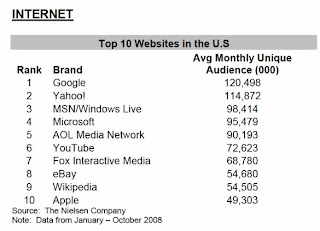
Figure 1 - Top 10 websites in the U.S.
Source: ChrisMonty, 2009
In the 21st century, the development of online media has presented new trends as social networking becomes one media that grew faster. This trend underlines the basic need of human being to have social life. Starting with messenger applications like MIRC, Yahoo! Messenger, and MSN among others; the need grows to have audiences that share something in common in a group. In this situation, social media like Friendsters, Facebook, MySpace, and Twitter grew rapidly.
The above developments are examples of new media creating new ways of communications in the 21st century. As every time, users or audiences might develop other contents that could be the next booms in cyber space, it is no doubt that internet together with the advancement in mobile gadgets will create many opportunities for new media and the way people in the world communicate.
Factors Contributed to New Media Development
1. Telecommunication Network
In the early 1990s, a book by James Martin with the title “Telecommunication and Computer” describes the early ideas of convergences technologies where computer works hand- in- hand with telecommunication network to enable the exchange of information. As the network already connects one location to another that is separated by ocean and using submarine cables, this exchange of information gets easier and faster.
Currently, there are two types of connection: wireline and wireless. Wireline refers to the media that use cables; meanwhile, wireless refers to telecommunication media that use propagated electromagnetic wave.
Wireline technologies have two main forms, in which each has different advantages and disadvantages in terms of lifespan, bandwidth, installation, and reliability. The types of wireline or cable include Fiber Optics, Shielded Twisted Pair (STP), Unshielded Twisted Pair (UTP), Coaxial etc. Wireless technologies also develop into several types such as microwave radio, satellite, and infrared, laser, etc.
2. Customer Premise Equipment: Mobility
The development in the telecommunication network was also followed by the advancement in the customer premise equipments. In 1980s, the majority of customer equipment that enables them to communicate is dominated by desktop phone. A decade later, the use of mobile phones start growing as people show tendency to mobile when doing businesses.
Historically, mobile phones development commences in 1983 when Motorola DynaTAC 8000X becomes the first handheld available commercially in the US market. Due to the attractiveness of cellular-based network like portability, roaming capability etc, the mobile phones industry immediately expand its services all over the world.
However, since many countries develop their new system and standard, we witness many kind of cellular phones standard such as TACS, C-Netz, AMPS (Advanced Mobile Phone System) that grew in the US, NMT (Nordic Mobile Phones), and GSM (Global Mobile Phone System), which grew in the Europe and become major standard in the world.
In addition to portability, mobile phones also have many benefits; they include data communication support, multi service/carriers support, and roaming capability, to name a few. The development of cellular phones is obvious when dealing with the visualization issue. Figure 2 shows the development of mobile phones that obviously differ in terms of visualization and appearance of the devices.
Figure 2 - Steps of Visualization in Cellular Phones
Source: gsmarena.com
3. Internet
In addition to telecommunication network and gadgets, another important innovation in the new media is internet. This is considered as critical to the development of new media as nowadays the exchange of information is carried out electronically. Unlike postcard or surface mails that take some days to reach the receivers, electronic mail can reach the intended receiver in just few seconds. Thanks to Tim Berners-Lee, the inventor of the famous World Wide Web, this becomes the basis of e-commerce. Historically, in 1989, Tim develops the internet-based hypermedia to help business to foster the information sharing between individuals, customers, partners and colleagues (W3, 2004).
Moreover, the development of internet technology also enables manufacturers and service providers to provide better services to their customers since Internet is widely accessible from almost anywhere in the world. Due to the unquestioned benefits that internet and electronic commerce (e-commerce) possess, we find that many and many corporations launch official websites to boost their sales.
Towards Social Networking
There are many inventions that characterize the development of digital era that emerge several decades ago, representing the combination two binary digits “0” and “1”. The coming of digital technology makes the development of gadgets much entertaining since information can be transformed into various forms (sound, picture, and video).
In addition, the convergence has present capability of internet to convey all type of information to be shared. Coupled with the increasing number of mobile phones and applications embedded have increased the number of users that access the internet by using their mobile phones. Figure 3 shows the top 10 website that accessed via mobile phones in the US (data in October 2008).
 Figure 3 - Top 10 most visited websites via mobile phones in the U.S
Source: ChrisMonty, 2009
However, this figure does not have similar condition in other part of the world, since each region or country has specific characteristics. For example, in the UK, the most visited website turns out to be UK Yahoo! followed by Google.co.uk and facebook.
1. Activities in Social Networking
The development of computer has enabled the information sharing between peers. Social networking websites provide mode personalized features that increased the possibility to share information within a group or among friends. The first popular social networking in early 21st century is friendsters.com. Friendsters enable user to search friend by school name, interests, location etc.
Several years later, other social networking websites like Facebook exist with better features than Friendsters. The features of Facebook enable users to posted video, comment on peers’ page, create quiz, etc. These features represent that user-generated content also play important role in determining the preference of users in using the social networking.
Figure 4 shows the activities that users do in the social networking websites in which it underlines that posting photos become the most activities that users do. The second most done activity is responding to posts of others. This condition represents that in the cyber space, people need to be recognized, have the need to share something with others, and communicate with others through comment on their status or photos.

Figure 4 - Activities in Social Networking (2009)
Source: Corwin, 2010
2. Social Networking web sites
As described previously, there are many social networking websites that grew fast in the 21st century. A survey studied the social networking membership based on the use of electronic mails (e-mails) reveals the following:
 Figure 5 - Users’ email and social networking membership
Source: Michael, 2009
The figure shows that when subscribing to social networking websites, a typical AOL and Gmail users connect to Facebook. Meanwhile, hotmail and Yahoo! users mostly become users of MySpace and Facebook equally. The other social networking website is Twitter, which is popular in the U.S. but not so popular in other part of the world since Facebook is still a dominant site (Michael, 2009).
Moreover, the following figure below shows the popularity that MySpace, Twitter, and LinkedIn have when compared to those email users on Facebook’s. For example, the number of Gmail users on Twitter is only 40% of the number of Gmail users on Facebook (Michael, 2009).

Figure 6 - Percentage of emails use in social-networking websites
Source: Michael, 2009
Blogs
Blog is one example of how technology helps a person to share ideas in the Internet for free. It is exactly similar to writing a column in a magazine or newspaper where people can also share ideas on particular subjects. By definition, blog refers to a “Web page that serves as a publicly accessible personal journal for an individual” (“Blog”). This web page can be updated several times as it reflects the personality and interests of the author. Blogs can be personal or organizational.
In addition, the existence of blog in e-commerce is very important since it becomes a new way of communicating at personal level by attracting audiences to comment and share their experiences. Blogs can deliver valuable and credible information to other customers and therefore will be an attraction for them to visit a company’s web site to give their opinions (Richmond, 2005).
As mentioned above, a Blog is somewhat similar to a public diary and sometimes it is more effective than online advertising or marketing. For instances, Tom Wark, owner of Wark Communications, a company that do business on wine industry, has a blog that display his comments concerning various issues on wine-related industry (Richmond, 2005). He believe that blog provide his company a great benefit since the number of traffic into his company’s web site becomes two fold.
However, the use of a blog will not directly lead to more money since people or readers do not pay for seeing or writing a blog, but it can become a tool for luring consumers to buy products or services the site has. Therefore, the company has the opportunity to create a massive customers database just from blogging.
Example of a powerful social network
In today’s internet era, the global internet network becomes the key driver behind the development of social network websites. They include the popular Friendsters, My Space, and the continually growing Facebook. Mark Zuckerberg discovered Facebook in 2004, using an initial investment of US $ 500,000 and in 2005 the company reported a net loss of $3.63 million. Facebook was originally a software-networking website dedicated and restricted only for Harvard College students. The website receives enormous attention from college students and only one month from its launch, half of the Harvard college students were registered on the service. The website then expanded to Stanford, Columbia, Yale and various other Universities in the United States (“Facebook”, 2010).
The company then launched a high school version of its service, requiring invitations before people could join the network, but the idea lasted only for 15 days before Zuckerberg changed the policy into allowing anyone to join. In the end of 2005, many institutions composing of 25,000 high schools and 2,000 colleges throughout the United States, Canada and United Kingdom had networks registered on Facebook. In the later part of 2006, Facebook became open to the public. After the website has been opened to the public, its number grew even further to include offices and companies around the world.
There are several different perspectives regarding the causes of Facebook’s strategic methods. Most of them however, agreed that Facebook’s success was based on the simplest and most effective marketing tool, which is word-of-mouth. Taking advantage of the social nature of human beings, it is appropriate for Facebook to focus its business marketing strategy simply by getting people to talk to other people about their products and services. Others however, believed that Facebook’s success is built from its unique offering of services and from a series of fortunate or supportive events. However, there are several conditions surrounding Facebook’s business environment that supported its success:
1. Powerful platform
Facebook’s platform has three important components, which are: identity platform, community platform and application platform. The identity platform underlines the fact that Facebook have rich metadata and they have massive intelligence on users. Users can even see detailed metadata regarding friends connected to them. Other forums and blogs do not provide such detailed amount of user’s data. The community platform on the other hand, represents the fact that Facebook’s ability to map relationships and affinities and segmenting communities from interests. As an application platform, Facebook uses API platform to gather intelligence from application deployment
2. Various applications media embedded and event management
Those are some of the most interesting features Facebook has offered to its consumers. These attributes generate significant progress for the company. For instant, in less than one month, the application sections exploded from hundreds to thousands. The application is created by a PHP developer. Within the system, audio, video and live streaming video are available. The richness of media embedded is one of the value creators of Facebook’s services. The affinity groups within Facebook can also organize and promote events from Facebook (“Facebook”, 2010).
3. Influential Conditions
Besides their unique attributes and service offerings, there are several conditions that contributed to Facebook’s phenomenal rate of growth, which are: invites through emails, increasing interests on group discussions, increasing trend in creating affinity groups and its limited search crawling
Analysts have strong predictions that Facebook’s limited market, which is in the college students market, is one of the important contributors of Facebook’s success. Thus, with its change of strategy opening the website to the public, some believed that Facebook will experience some level of sales reduction. On the other hand, Facebook’s competitors believed that the market niche of college online social group will not vanish, and will in fact, has as profitable potential as ever. These competitors include College OTR.com, CollegeTonight.com and CollegeWikis.com, which all plan to remain loyal to the college market niche. These competitors are expected to pose as potential threats for Facebook.
In reality, Facebook did not lose its market niche, but it is searching for new and more promising ones in other types of communities. It is recorded that instead of experiencing a decline in revenues as predicted by other companies, Facebook has experience an increase in other segments of the online social network market. These other segments include the professional segments of employees and managers and the public in general. Some believed that Facebook would not experience any reduction of customers, but simply jumping to new market base. Competitors might have been advantageous by Facebook leaving the college market, but Facebook is actually more advantageous from the joining of the business and professional segment.
Computer Mediated Communication (CMC) & Face -to- Face Communication
Communication has always been an integral part of human relationship either for work or for personal purposes. As the objective of communication is diverse, the way we communicate also varied. In addition, technology has been the strongest factor that allows such practices.
Computer mediated communications has rather different methods of communication and interaction compare to the traditional face-to-face communication. The differences between these two communication styles lie on several respects. For instance, analysts indicated that compare to the traditional face-to-face communication, computer mediated communications has a rather weaker presentation of ‘self’. For instance, in a traditional face-to-face communication, people are communicating by means of audio and visual connections with each other. Within a chat-room for instance, people are communicating through text messages and text messages alone. Compare to the traditional face-to-face communication, this generates larger possibilities of misunderstanding between the communicating parties. Moreover, the audio and visual connections are strengthening by an actual presence which generate the feeling of closeness and intimacy; and facilitate stronger understanding through human emotions and interpretations. The inability to see facial expressions, voices, and gestures makes it hard to guess and interpret the responses received from other participants.
Moreover, the rate by which messages exchange in cyber world is always associated with thinking process that delays response time and this count for another main difference between face-to-face communications and computer mediated communications. Speaking is much faster as a response as compared to typing (Spears, 1994).
However, computer mediated communications is sometimes preferable because it generate less tension and less pressure of meeting face-to-face with new people. As compared to face-to-face communication, computer mediated communications always require selected features of an identity of a communicator. Any mode of computer mediated communications that is being used by a communicator, lets him or her have some time to develop a response to a message thereby it eliminates any forms of anxiety because of the anonymity of mode of communication being used. Therefore, participants feel free to express their opinions and to talk and debate about their rights, as they are aware that they are not being exposed (Tidwell and Walther, 2006). In addition, participants and communicators in different forms of computer mediated communications can exhibit different traits and characteristics defined by different situations. Thereby communications can become less personal depending upon the situations in which communicators reside, and may serve to decrease any intimacy between communicators. Moreover, higher level of task orientation is achieved in CMC based communication as compared to face-to-face communication.
Conclusion
Media and society are inseparable. This is due to the fact that currently media has been an integral part of our lives. Consider the flow of information that we obtain through various kind of media from printing media like newspapers to popular internet. The development of online media has promoted the new trends of communication where people are likely to communicate through social networking. This situation highlights that the basic need of human being to have social life. Therefore, social networks like Friendsters, Facebook, MySpace, and Twitter grew rapidly.
This paper has identified three aspects that contributed to this phenomenon; telecommunication network, mobile equipments, and internet. Telecommunication network is essential in the development of information technology (IT). Meanwhile, customer equipments also important as it allow users to connect to the Internet. Currently, the customers’ equipment goes mobile as people need mobility to do business and communicate with others. Beside telecommunication network and gadgets, another important innovation in the new media is internet as it allows the exchange of information in a broader perspective.
In addition, Computer mediated communication (CMC) is the latest form of communication between social groups and users. Many factors in computer mediated communication have been revisited that make it different from face-to-face communications. These differences may or may not be playing their roles in rendering these communications as personal or less personal.
Works cited
ChrisMonty. “Most Popular Website and Mobile Sites in ‘08: Google, Yahoo Mail” 2009
Corwin, Peg. “What Do Site Users Do in Social Networking Websites?” 2010
"Facebook." Wikipedia, the free encyclopedia. 2010
Michael. “Social Insight into AOL, Gmail, Hotmail, and Yahoo Email Users – Part 3: Social Network memberships.” Rapleaf. 2009
Richmond, Riva. “Blogs Keep Internet Customers Coming Back.” Wall Street Journal. 2005
Spears, Russell. "Panacea or Panopticon? The Hidden Power in Computer-Mediated Communication." Communication Research 21.4 (1994): 427-459.
Tidwell, Collins, Lisa., and Walther, B. Joseph. “Computer-Mediated Communication Effects on Disclosure, Impressions, and Interpersonal Evaluations: Getting to Know One Another a Bit at a Time.” Human Communication Research 28.3 (2006): 317 – 348.
W3. “Tim Berners-Lee.” 2004.
Walther, B. Joseph., Slovacek, L. Celeste., and Tidwell, C. Lisa. “Is a Picture Worth a Thousand Words? Photographic Images in Long-Term and Short-Term Computer-Mediated Communication.” Communication Research 28.1 (2001): 105-134.
Friday, February 26, 2010
The Effects of MySpace on the Music Industry
Mike Stanzione
Professor Lance Strate
Understanding New Media
27 February 2010
The Effects of MySpace on the Music Industry
The internet has undergone a dramatic shift in recent years toward the direction of user-created content. Web pages are more than just static content – users are able to create and edit content themselves as well as interact and form communities on these sites. Today pretty much anybody with an internet connection can create a blog or an account on a social networking site and immediately begin creating content and interacting with other users. The recent rise of the internet has also affected a number of other forms of media. One industry that has suffered a great deal has been the recorded music industry. With sales dropping, stores closing, and executives being forced to re-evaluate their priorities and change their business models, the music industry has seen a great deal of turmoil in recent years due in large part to internet activity. It is also due to this new type of web content that the music industry has changed as well. User-created content centered around music has been a driving force in the success of many sites, with one being an especially notable example. MySpace, a site created for social networking purposes, found popularity through the music elements featured on the site. Musicians were able to use the site as an outlet for their music and way to reach out to new and existing fans. Fans in turn could interact with and around their favorite performers and also find new music. Many artists have been able to find success with the help of MySpace, and the site’s efforts have also changed the way many labels do business. Even though the site has undergone changes of its own in recent years, its effects on the music industry still remain.
The music industry has undergone a number of changes over recent years. File sharing and digital downloads have altered the musical landscape. CD sales have been declining annually from 10 to 20 percent over the last few years (Stone), which has made it difficult for record stores to survive. For example, Tower Records was forced to file for bankruptcy in August of 2006 due to losses of over $210 million (Knowles 9). Despite the growth of digital music sales over recent years (Dhar and Chang 9), most internet users consider music to be free (Knowles 9). The introduction of new technologies has also created a “democratization” of sorts of the music industry. Musicians are now able to produce their own music, which has led to an explosion of content (Knowles 7). The increase of available content as well as the ability for this music to be distributed freely through the internet has created a demand for music that the industry that made it difficult for physical stores to survive. The demand for out-of-print, niche, and obscure music increased at the expense of more mainstream artists, which caused file-sharing as well as online distributors to thrive at the expense of stores like Tower (Knowles 8). This change in demand has been called “The Long Tail” by Chris Anderson, which refers to a pattern of distribution where mainstream hit sales constitute the “head” of the pattern, with “decreasing demand flowing through to a long ‘tail’ made up of lesser selling titles” (Knowles 8). Digital distribution has considerably helped to increase the length of this “tail,” with “long tail titles” making up nearly 40% of music sales in 2006 (Knowles 8). As a result, the demand for mainstream acts has decreased with this increase in demand for niche and lesser-known artists (Knowles 8-9). These developments have caused users to seek their music through new outlets.
New media technologies such as social networking and blogging have allowed users and artists to connect to each other in new ways. Social networking has been able to allow artists to connect to their fans in a number of ways (Beer 224), and blogging can both distribute and review music as well (Knowles 7). The movement towards user-generated content on the internet has been dubbed Web 2.0, which “looks to harness ‘collective intelligence’ through the development of a ‘participatory culture’” that allows “users to become ‘co-developers’ by generating as well as browsing content” (Beer 226). The various Web 2.0 websites have attracted millions of users (Beer 228) and have dramatically influenced the music industry. One of the best examples of this trend is the social networking site known as MySpace.
MySpace was created by Brad Greenspan, Tom Anderson, Chris DeWolf, and Josh Berman, who were all members of e-Universe. The site launched in August of 2003 and was “built upon the social dynamics of America Online, CompuServe, message boards, forums and computer conferencing” and has grown to include over 300 million accounts as of 2009 (Levinson 110-111). MySpace was not the first social networking site – Friendster had already emerged before it and become popular on the internet as a dating site. Because of this nature, it did not allow “non-personal profiles,” which prevented musicians from using the site. Tom Anderson took note of this, and created a strategy for MySpace that would include those not allowed on Friendster (Shklovski and Boyd 1). Anderson allowed musicians to use the site to connect with fans as well as promote themselves. In additional to bands and the casual user, the site was also populated by band managers, club promoters, and independent musicians who “leveraged the site to promote local bands and provide VIP access to a handful of premier clubs” (Shklovski and Boyd 1). In response to the number of artists who were joining the site as well as the closing of MP3.com, which allowed artists to post their music online, MySpace launched music profiles in 2004. These profiles were different than the traditional MySpace profile in a number of ways. Although they followed the same structure of most social network profiles by including description, a list of friends, and a comment section, these profiles were listed separately from regular users, allowed bands to list their shows, and perhaps most importantly, gave artists a way to distribute their music (Shklovski and Boyd 1). The site built in a player that allowed musicians to upload songs to their profiles, which users could then stream directly from the page. A few months later MySpace allowed non-music users to stream these songs from their own profiles (Shklovski and Boyd 1). Artists are able to customize the content of their profiles however they like, and are able to post a variety of things on these profiles such as upcoming shows, blogs, videos, podcasts, and other forms of content in addition to their music (Beer 230). In September 2004, R.E.M. unveiled their upcoming album on the site, allowing fans to listen to the album online weeks before its release date. This changed the reputation of MySpace to “something other than a dating site” (Shklovski and Boyd 2). As the site grew in popularity, the site continued to focus on music. In March of 2005 MySpace allowed bands to create simpler addresses for their profiles, making it easier for the bands to advertise their pages. MySpace also created a record label, started a MySpace tour, and put out a compilation CD in November of 2005 (Shklovski and Boyd 2). The social networking aspect of the site combined with its musical features allowed the site generate “more community-related music activity than any other music-related site” according to a 2006 report from Jupiter Research (Shklovski and Boyd 1).
MySpace has proven to be effective for artists in a number of ways. The site allows artists to promote themselves in a number of ways, such as by posting messages on the site and reaching out the new people (Shklovski and Boyd 2-3). The community aspect of the site has proven to be a valuable tool to musicians as well. Artists can find potential fans by promoting themselves on the page of a similar artist, asking people to listen to their music as well (Beer 234). Bands are able to connect with each other as well, allowing them to foster existing relationships as well as build new ones in an effort to help each other out along the way. Bands have been able to use the site to set up shows with each other as well as help smaller bands play in new environments that they might not have had the chance to without these resources (Shklovski and Boyd 2). However, as important as the community aspect between bands may be, this relationship is not as crucial as the one between the one between musicians and their fans.
MySpace, like other social networking sites, operates by collecting “friends” on the site. MySpace does not distinguish between different types of “friendships” on the site, so fans are able to add bands as “friends” and vice-versa (Shklovski and Boyd 3). The fans and artist can then interact between each other. Fans can post comments on the artist’s blog or profile, and the artist can join in the discussion as well. Comments can spark ongoing discussions between fans as well. In a sense these profiles not only serve as “a portal through which the fan base can communicate with the popstar, or a space where the popstar (or the music industry) can communicate information to the fans” but also an outlet that creates networks of friends around the performers (Beer 231, emphasis in original). The artist does not need to be present for the community to survive – it operations regardless of whether or not the artist is in attendance during the various discussions and comments in order for the interaction and connections to continue (Beer 231).
MySpace has allowed bands and fans to create a sort of mutually beneficial relationship on the site. Bands can “collect” fans, allowing them to promote to a larger audience, while fans are able to “friend” a band to display their fandom, receive updates from the band, and show their support through comments (Shklovski and Boyd 3). Fans use music as a form of self-expression, and often select songs to display on their profile based on how they identify themselves. This feature has been considered to be an effective way to spread new music to friends and was an important reason why Jupiter Research considered MySpace to be the most influential music site (Shklovski and Boyd 3).
MySpace essentially created a new way for fans to obtain information about their favorite artists. The social networking sphere allows musicians to “become part of the communicative flows of the social networking site” by “checking and updating their profiles, making friends, posting music, and so on” (Beer 232). This allows fans to connect directly to the artist and not through a magazine, radio, or TV show (Beer 232). Regardless of whether or not the musician himself is the one checking the page, there is still the perception of communicating directly with the performer, which “fits with the broader rhetoric of democratization and participation that has ushered in Web 2.0” (Beer 232). However unlikely it may be that Mick Jagger himself logged on to the Rolling Stones MySpace, it still creates a “perception of accessibility” (Beer 232) that has gone on to challenge the way music culture is organized (Beer 234).
A number of recording artists have been able to help their careers with the help of MySpace. Lily Allen, a singer from London, created a profile where she posted demos of her music. She began to attract a number of fans as well as mainstream press attention. She would go on to have a top single in the United Kingdom and an album that has sold over three million copies (Levinson 117). MySpace was definitely instrumental in her success.
The success of Lily Allen through MySpace was also instrumental in the career of another singer from London. Kate Nash started her music career by recorded some songs at home that she posted on MySpace. She would then reach out to Lily Allen through the site, asking her to listen to her music. Allen liked what she heard and recommended Nash on her own page, asking her fans to check her out. Thousands of people would go on to listen to Nash’s music after this recommendation, which caused her fan base and concert attendance to increase dramatically. After releasing a single on an independent label, she would soon be offered a contract by a major record label. Her first album, “Made of Bricks,” reach the top of the United Kingdom music charts (Pareles). Her songs were played over 20 million times on MySpace alone (Levinson 116).
Another example is that of Sean Kingston, who found the MySpace account of record producer J. R. Rottem. Kingston repeatedly contacted Rottem in 2007, claiming to have sent him messages “eight time a day for, like, four weeks” (Levinson 117). Eventually Kingston’s persistence paid off, as Rottem eventually took notice. He would soon have number one songs in the United States, Canada, and Australia (Levinson 117).
In 2007 a teenager was able to ride use MySpace and other websites to get the number one single in America during the summer. DeAndre Ramone Way, who is known as Soulja Boy Tell ‘Em, started off by uploading his self-created songs to the website SoundClick.com. He was able to sell his songs for 99 cents each, reaching over 35,000 downloads daily on the site (Arseniuk). Despite making nearly $20,000 a day on that site, he realized that MySpace attracted larger audiences and started posting his music there. After finding a manager and putting his contact information on his profile, he received numerous calls for live performances. His independently released debut album was extremely successful, despite receiving no major label backing. As his online reputation began to grow, he eventually got the attention of Michael Collipark, who would sign Soulja Boy to Interscope Records in 2007. He re-recorded and released his album on the label, shot music videos, and soon had the number one single in the United States for seven weeks in the summer of 2007 (Arseniuk). He even created a video on YouTube that teaches people how to do the dance in his music video, which got over 40 million videos (Arseniuk). In addition to the money earned from record sales and downloads, Soulja Boy is now also able to generate revenue through ringtone sales, his own record label, and even his own clothing line (Arseniuk). Despite the success he was already enjoying on SoundClick.com, his migration to MySpace was an extremely significant move in the career of this performer.
One final example of somebody who has used MySpace to launch a musical career is that of Tila Tequila. Tila Tequila caught the attention of record labels for having the most friends on the website, but actually rejected a number of offers she received (Aspan). Despite the fact that the music on her website has been said to “veer between incompetent and unlistenable” (Weiner) and many contribute the success of her page to the fact that it is full of provocative pictures, she has spent considerable time at the top of the MySpace charts ahead of plenty of established artists (Weiner). People were quick to point out the flaws in the system – that the charts were based on total page views and nothing more – but the buzz created around Tequila was enough to attract industry attention. She now has a clothing line, a number of magazine covers, and an endorsement contract with a cell-phone company (Weiner), in addition to a television show. Despite her insistence to go around record labels, many people noted that her strategy would not cause significant damage to the industry. With no prior recording history and little attention on music-specific communities, some researchers doubt the ability of Tila Tequila to be overwhelmingly successful as a recording artist (Aspan).
Despite the success these artists were able to reach through their presence on MySpace, as well as the boost the site has given to bands such as Fall Out Boy, My Chemical Romance, and Panic! At the Disco (Weiner), some critics feel that the site is not as successful in finding talent as some people would like to believe. Critic David Hajdu cites Bruce Springsteen as an example, who had to play in small bars before he could make records, as opposed to these artists who get record deals with little more than a MySpace following (Weiner). Regardless of the criticism, the site has still brought a number of artists into the mainstream and also been important to the careers of others.
In 2005 MySpace decided to take its musical aspect a step farther and created its own record label. The company joined up with Interscope Records to create MySpace Records, a label created to “support niche artists as well as break-through acts expected to become mainstream” (BusinessWire). Although it was created as a partnership with Interscope, MySpace Records was designed to “operate as an independent label, structured with its own marketing, publicity and A&R business units, all designed to capitalize on the existing MySpace infrastructure” (BusinessWire). The label aimed to develop its independent acts as well as assist Interscope with larger acts. The first band signed to the label was Hollywood Undead, who used MySpace to build a following at a rapid pace and quickly move to the top of the site’s charts (BusinessWire). The label would also go on to add established artists such as Pennywise, as well as artists such as Kate Voegele and Mickey Avalon, who would eventually be promoted to the main Interscope label (Kincald). However, the MySpace Records label itself did not have any major commercial successes (Rodriguez) and rumors have circulated that the label may be disbanding (Kincald). Although those rumors have yet to come to fruition, in January the label did let go of a number of staff and its General Manager Jay Scavo returned to his old label Hollywood Records. Despite the reshuffling that went on, the label announced that its artists would remain signed and the partnership with Interscope would continue (Kincald). Regardless of what eventually happens to the label, it still has proven to be important for a number of artists. In addition to a few acts that would eventually find their way onto the main Interscope Records roster, Hollywood Undead would also go on to become very successful. Unfortunately for MySpace Records, however, this success would be with another label. Not long after signing the band, the label had a dispute with them over the content of their album. The band refused to compromise, which would cause the label to let them go. The band was then moved to A&M/Octone, another label in the Interscope family. The band would then go on to sell over 600,000 copies of its debut album (Rodriguez). Even though they reached success with a different label, Hollywood Undead was still able to use MySpace Records as a springboard to their music career.
In addition to fostering relationships between fans and musicians, sites like MySpace and other Web 2.0 websites have proven to be effective resources for advertisers and researchers. These sites can provide a great deal of data than can be useful for marketing purposes (Beer 237). The millions of people that use sites like MySpace also create large potential audiences for advertising (Stone). Advertisers have been able channel information gathered from social networking sites and can advertise accordingly (Gallagher). Studies have also shown that pages on the site belonging to major recording artists generally receive the most visits, which reflects “established offline hierarchies” (Jean-Samuel and Thomas 189). This is another piece of information that could be useful to advertisers. MySpace has also proven to be important to advertisers because of its demographics. Studies have shown that “internet users over 13 years of age who access music through social networking sites spent $70 per capita on CDs, paid downloads and music subscriptions, more than double the $25 per capita spent by those not using social networks” (Gallagher). The ability to target ads to a potentially receptive audience is no doubt appealing to a possible advertiser.
In 2006 MySpace made its first attempt to sell music directly through its site. In September 2006 the site announced that it would sell music as part of a partnership with Snocap, which was a company created by Napster creator Shawn Fanning (Levine). The company created the music store as a way to compete with iTunes, with the hopes that fans who were listening to music on a band’s page could then buy the music right there without having to go to another website. The music store was designed to work with the four major record labels, but was also designed to allow independent labels and unsigned bands into the system as well (Levine). The Snocap database featured an audio fingerprinting technology that would prevent illegal selling of the files and also allowed labels to set their own prices, which iTunes did not allow at the time (Levine). This was another important development for MySpace as a music site, as it not allowed opened up a new source of revenue for the site (Levine), but it also created yet another avenue for the site to go down in the music industry. The fact that labels were willing to join in this MySpace/Snocap partnership shows how legitimate MySpace had become at this point. MySpace had become more than just a website for bands to make a page on – it had now become a digital music retailer.
In addition to the effects it has had on the online music world, MySpace has also had its effects on the more traditional aspects of the music industry as well. The introduction of its own record label has put artists in stores that may not have found their way onto shelves otherwise. Many of the aforementioned artists were also able to launch or assist their careers with the help of the website. The previously mentioned “long tail” of the music industry made up a large percentage of record sales in 2006 (Knowles 8), with many of these artists also considered to be the most recommended on the site (Jean-Samuel and Thomas 189). Even though the site reflects popular music trends in the sense that 10% of artists receive 90% of the page views on the site (Jean-Samuel and Thomas 189), studies have also revealed that these popular artists are not by any means the most influential or recommended (Jean-Samuel and Thomas 189). Even if these artists may be drowned out in older media forms, they can still have a presence on MySpace and reflects a growing democratization of the industry (Beer 223). Now musicians can even chart without a record contract, as the band Koopa did in the United Kingdom (Beer 223).
Studies have also been done to see just how effective the effects of Web 2.0 content can be in terms of album sales. Past research has shown that word of mouth and peer reviews have been effective in influencing the opinions on movies, and that “better” movies seemed to attract a greater number of postings in return (Dhar and Chang 3-4). In an attempt to apply these findings to music sales, a study was done that measured a sampling of blog posting and MySpace friends over a period of time of a number of albums’ life spans (Dhar and Chang 7). The study was unable to obtain Nielsen SoundScan data to track album sales, but instead used sales rankings on Amazon.com (Dhar and Chang 9). The study done by Vasant Dhar and Elaine Chang suggested that “higher blog post volumes and higher percentage changes in MySpace friends correspond to increased weekly sales in the future” (15). Although the study found out that an increase in blog posts corresponds to a greater increase in sales than an increase in MySpace friends (Dhar and Chang 16), a relationship does seem to exist. There is also the theory that an increase in blog chatter and MySpace friends could very likely be due to the quality of the artist of the album itself (Dhar and Chang 18), there is still a relationship between Web 2.0 content and album sales. In addition, there are a number of older, more established artists who had very few MySpace friends, which could also mean that their older fans likely do not use MySpace (Dhar and Chang 20). Although the study itself even admits that further study is needed and that it is dangerous to assume causality from its findings (21), the authors posit that this sort of information could be used by record labels in an attempt to predict sales (21). The authors also suggest that genres of music that are not covered in mainstream media sources might also benefit more from online activity than more popular styles (21-22). Even if the number of MySpace friends may not prove to be an accurate measure of the future success of an album, it has already been shown that artists with large numbers of fans on the site have been able to catch the attention of people in the music industry. It also bears repeating that a 2006 study revealed that people found music more often on MySpace than on any other site (Shklovski and Boyd 1), which likely had at least some sort of effect on the record sales of some artists.
MySpace has proven to be so effective in linking together fans and artists that record labels have recently attempted to implement their own social networking capabilities. In January of 2009, Warner Music announced that it would be implementing a social networking platform onto its websites (Gladkova). The label introduced these tools to allow fans to interact with their favorite artists on their own websites rather than have them go to another site (Gladkova). Market research has revealed that many fans do go directly to an artist’s website, so the label decided to implement this technology in an attempt to keep viewers on the site for longer periods of time and possibly increase sales (Gladkova). Although the label does not intend to compete with MySpace (Gladkova), the introduction of social networking to its websites shows that record labels have taken notice of the effectiveness of MySpace and are trying to get a piece of social networking revenues for themselves (Gladkova).
Although MySpace had become an extremely popular social networking and music site, it began to lose a great deal of users over recent years. MySpace has been surpassed by Facebook as the top social networking site, and has lost millions of users in the process. Although MySpace had 64 million users in August 2009, that number is 12 million users fewer than just one year prior (Perez). Around that same time, Facebook got its 300 millionth user (Perez). Recently MySpace announced that it was “giving up on trying to be a major social network” (Perez) and instead changed their direction to a more music-oriented one. Although the site has been built around music for quite some time, the new strategy aims to create “a site for socializing around music instead of a site for just socializing” (Perez). It was with this strategy in mind that the site launched MySpace Music.
On September 25, 2008, MySpace launched MySpace Music, a music service launched in collaboration with the four major record labels (Sandoval). The partnership was created with Warner Music Group, Sony BMG, Universal Music Group, and EMI, and is designed to make money through a combination of advertising and digital music sales (Stone). Although the company had attempted digital sales before, the updated strategy also implemented the ability to instantaneously stream any song from the millions available in the site’s database for free (Stone). Users were also given the ability to create their own playlists of songs, which could then be posted on their profiles and shared with friends. Fans who wanted to download the song itself onto their own computers could do so through the digital music store on Amazon.com (Stone), which is implemented directly onto the MySpace page (Sandoval). Ringtones are also provided through the site, which can be purchased through Jamster (Sandoval), which is also owned by News Corporation, the parent company of MySpace (Stone). The labels themselves all hold a stake in this project as well, owning about 40% of this venture (Stone). Although MySpace would not comment on the terms of the deals made with the record labels, it has been speculated that the “penny-a-play fee” that other streaming music sites must pay has been waived for MySpace (Stone). The site also announced plans to eventually add exclusive music and video content as well as create deal to encourage more downloading (Stone). Concert ticket and merchandise sales are two more revenue streams that the site plans to implement in the future as well (McCarthy).
MySpace Music started off very well for the site, citing high traffic and usage. By the end of its fifth month over 5 million bands had music on the service and more than 100 million playlists were created (McCarthy). The site also claims that it hit its billionth stream after only a few days (McCarthy). Although MySpace Music seems to have had its share of early successes, it is still too early to tell just how successful it will be in the long run. It remains to be seen whether or not Facebook will introduce a competing music service, which would prove to be a significant challenger to MySpace Music (Gallagher). As mentioned earlier, MySpace has already lost millions of users to Facebook over recent years, but shifting the focus of the site could ultimately help MySpace remain profitable (Perez).
It is still early to speculate on the fate of MySpace Music and whether or not it will work out for MySpace itself in the long run. However, this shift in strategy reflects the important role that music played throughout the history of MySpace and will also play a large role in its future. Whether or not MySpace Music succeeds remains to be seen, but what the site has meant for the music industry is definitely notable. A number of artists have been able to use the site in a number of ways to connect to their fans as well as find new ones. Fans in turn can also use MySpace to connect directly with their favorite artists, creating an aura of approachability that was once missing from music. Although overall record sales have declined over the years, “long tail” artists have seen an increase in their sales thanks to MySpace and other similar sites. Many musicians have also used the site to break into the industry, as with musicians like Kate Nash and Soulja Boy using the site to get noticed. Even a singer with no musical background like Tila Tequila could get the attention of record labels with the help of MySpace. Record labels have adopted social networking capabilities recently as well, an indication of how successful MySpace has been in combining music and social networking. Despite losing its rank as the top social networking site, MySpace has proven to be an extremely valuable resource to both musicians and fans and has had a profound effect on the music industry.
Works Cited
Arseniuk, Melissa. "Teen Rap Sensation Outlines Success to CES Crowd." Las Vegas Sun. 07
Jan. 2009. Las Vegas Sun, Web. 27 Feb 2010.
crowd/>.
Aspan, Maria. "The Toast of MySpace Tries the Music Business." NYTimes.com. 26 Feb. 2007.
The New York Times, Web. 27 Feb 2010.
Beer, David. "Making Friends With Jarvis Cocker: Music Culture in the Context of Web 2.0."
Cultural Sociology 2.2 (2008): 223-241. Web. 27 Feb 2010.
Dhar, Vasant, and Elaine Chang. "Does Chatter Matter? The Impact of User-Generated Content
on Music Sales." CeDER Working Papers. Feb. 2008. New York University, Web. 27
Feb 2010.
Gallagher, Sean. "Doubts Loom Over MySpace Music Strategy." Internetnews.com. 02 Oct.
2008. Web. 27 Feb 2010.
news/article.php/3775361>.
Gladkova, Svetlana. "Music Industry Getting Serious About Social Networking." Profy. 10 Jan.
2009. Profy, Web. 26 Feb 2010.
serious-about-social-networking/>.
Jean-Samuel, Beuscart, and Couronne Thomas. "The Distribution of Online Reputation:
Audience and Influence of Musicians on MySpace." 2009. Association for the
Advancement of Artificial Intelligence, Web. 27 Feb 2010.
Kincald, Jason. "MySpace Reshuffles its Music Label." TechCrunch. 14 Jan. 2010. TechCrunch,
Web. 27 Feb 2010.
Knowles, Julian. "A Survey of Web 2.0 Music Trends and Some Implications for Tertiary Music
Communities." QUT ePrints. 24 Sept. 2007. Queensland University of Technology, Web. 27 Feb 2010.
Levine, Robert. "MySpace Music Store is New Challenge for Big Labels." NYTimes.com. 04
Sep. 2006. The New York Times, Web. 27 Feb 2010.
Levinson, Paul. New New Media. Allyn & Bacon, 2009. Print.
McCarthy, Caroline. "Catching Up With MySpace." CNET News. 11 Mar. 2009. CNET, Web.
27 Feb 2010.
"MySpace and Interscope Records to Launch 'MySpace Records'." BusinessWire. 07 Nov. 2005.
BusinessWire, Web. 27 Feb 2010.
Records-Launch-MySpace-Records-Community>.
Pareles, Jon. "Not Too Famous to Mind Her Mum." NYTimes.com. 06 Jan. 2008. The New York
Times, Web. 27 Feb 2010.
Perez, Sarah. "Can Music Save MySpace?" Read Write Web. 22 Oct. 2009. Web. 27 Feb 2010.
Rodriguez, Dan. "Could Hollywood Undead Have Saved MySpace Records?." Metal Insider. 18
Jan. 2010. Metal Insider, Web. 27 Feb 2010.
Sandoval, Greg. "MySpace Music Makes its Debut." CNET News. 24 Sep. 2008. CNET, Web.
27 Feb 2010.
Shklovski, Irina, and Danah Boyd. "Music as Cultural Glue: Supporting Bands and Fans on
MySpace." 2006. Web. 27 Feb 2010.
Stone, Brad. "A Jukebox on MySpace That Takes Aim at Apple." NYTimes.com. 16 Sep. 2008.
The New York Times, Web. 27 Feb 2010.
Weiner, Jonah. "Tila Tequila, the First Star of MySpace." Slate Magazine. 11 Apr. 2006. Slate,
Web. 27 Feb 2010.

 Posts
Posts

